
01 / Everyday use
You booked a journey, not an airspace seminar.
A traveler books connecting flights to visit someone. Behind the itinerary, dispatchers assess the route and the conditions under which it can be flown. When those checks fit the schedule, passengers mostly notice the gate and the coffee queue. Safe operation depends on work that a booking confirmation has very little room to explain.

The calendar is not flying the aircraft.
A scheduled arrival is a plan subject to operating constraints.
Visual metaphor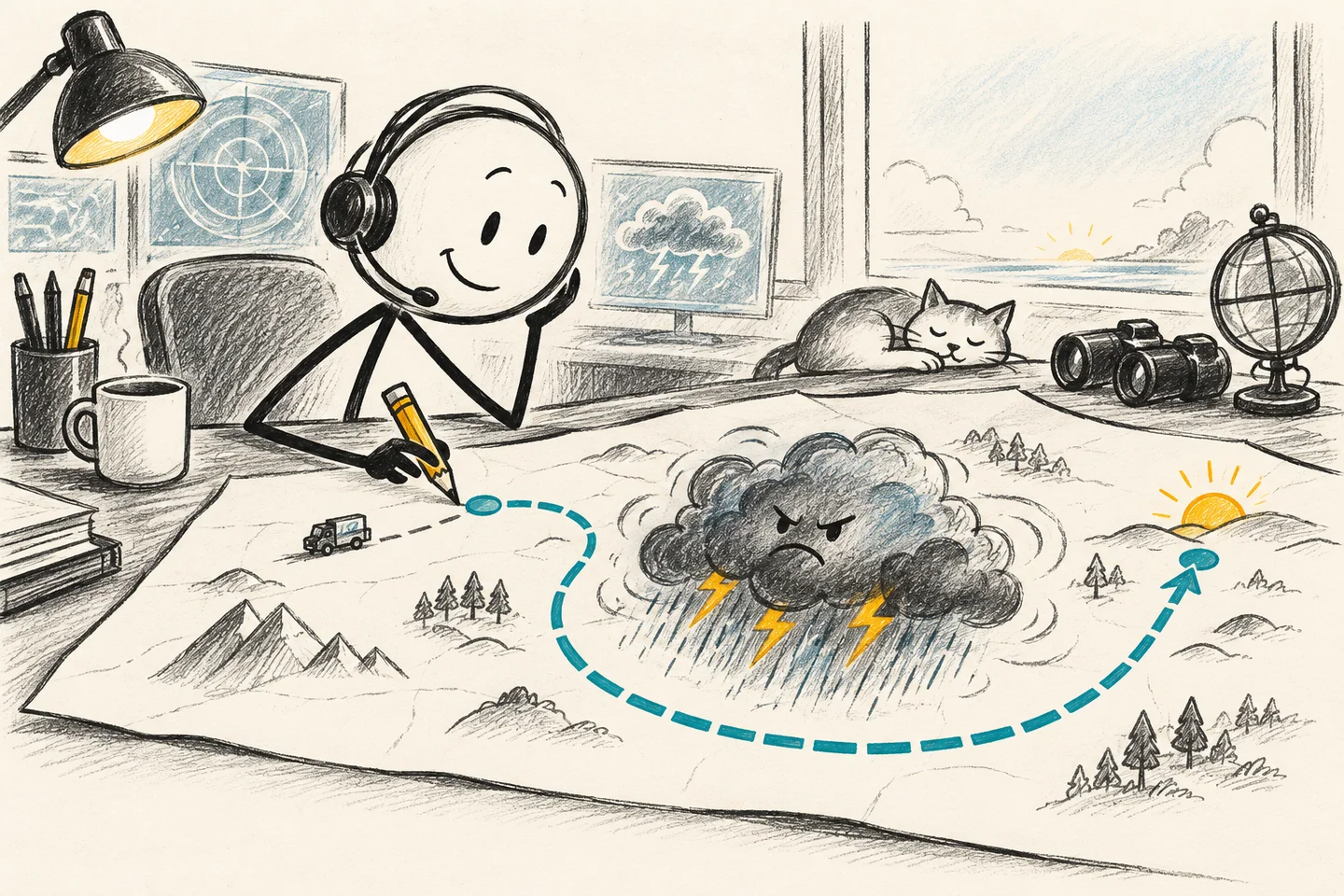
02 / How it works
The shortest line is only one candidate.
Airlines assess risks when choosing routes. Conflict-zone information can inform that work alongside operating constraints. The drawn hazard and curved path are visual shorthand, not a geographic map or a statement about an active restriction. Taking a longer route can preserve the journey’s safety while changing the time and resources required to complete it.

Two tickets can share one problem.
An alternative route is useful only if it avoids the relevant constraint and is available.
Visual metaphor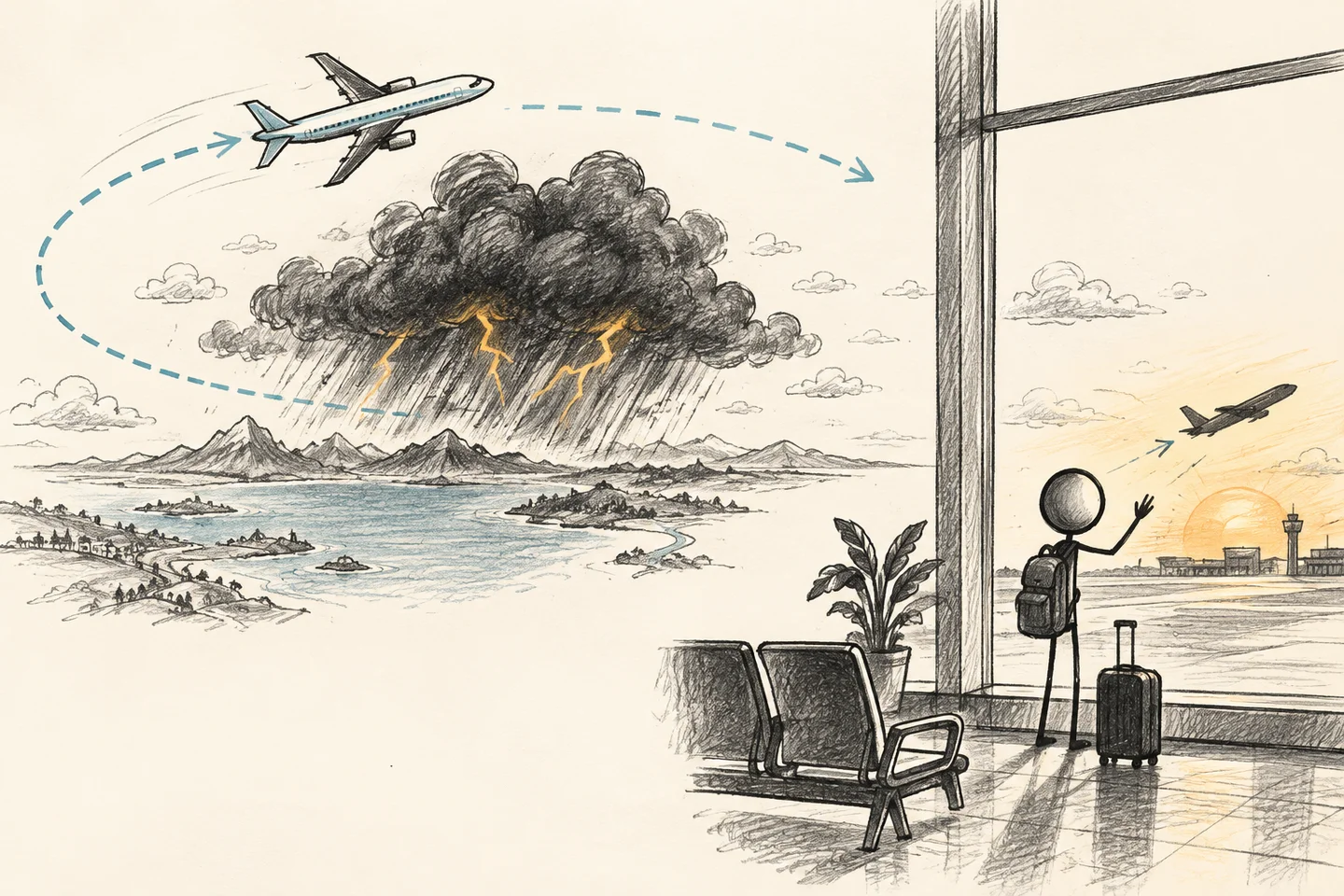
03 / Failure
A safe detour can still miss the connection.
Suppose an airline reroutes a flight around a hazard and the added journey time exceeds the connection buffer. If the onward flight departs before the traveler reaches it, the traveler needs another departure. With no suitable seat that day, an overnight stay may follow. None of those outcomes is automatic, and this example describes no identified passenger.

A little room can absorb a little delay.
Connection time is a buffer, not a guarantee against disruption.
Visual metaphor
04 / Recovery
Build room for a route to change.
Check the operating airline’s current flight information and contact it about viable onward options after a disruption. An itinerary with more connection time can absorb some delay; an alternative may help if it avoids the same constraint and has seats. These measures cannot guarantee arrival. Check the booking’s terms before assuming a replacement or overnight expense is covered.
The dated intelligence assessment
What the reporting shows
Direct U.S.-Iran fire returned around the Strait of Hormuz after a month without an exchange, pushing oil higher and keeping aviation and shipping risk real even though neither side publicly framed the episode as a return to full-scale war. The immediate operating picture is selective disruption, not regional shutdown. Separately, a court-driven visa change, a federal breach, and a water-sector vendor leak each require scoped verification by the people actually exposed.
- Treat Gulf airspace and maritime routing as route-specific, not binary: official warnings narrowed in some places and extended in others.
- Water utilities and federal-adjacent operators have concrete follow-up work; unrelated organizations do not need emergency theater.
- Applicants from the 75 affected nationalities should verify their individual immigrant-visa case status because the January issuance pause is no longer in effect.
Ranked by consequence
Critical developments
U.S. and Iran trade direct fire around the Strait of Hormuz
Evidence, consequence and unknowns
The bombs are back
U.S. forces struck two Iranian launchers on Larak Island after reporting an imminent minelaying threat; Iran answered with missiles at two U.S. bases in Jordan. U.S. defenses said they intercepted the missiles capable of causing damage.
One-fifth of the world's oil
The exchange restores a short-warning military pathway inside a corridor already constrained by the war, sanctions, and disputed control of the Strait. A limited strike can still move freight, fuel, insurance, and airline decisions faster than diplomacy can clarify intent.
Neither side brought receipts
Casualty and battle-damage claims remain partly dependent on the belligerents. Neither side's public preference for a bounded exchange guarantees the next response will remain bounded.
EASA extends Gulf conflict-zone warnings through September
Evidence, consequence and unknowns
The warnings got narrower, not smaller
The European Union Aviation Safety Agency revised active bulletins for Jordan, the Persian Gulf and Gulf of Oman, Lebanon, Iraq, and Iran through September 30. It narrowed some Gulf restrictions while keeping operations over Persian Gulf and Gulf of Oman waters constrained.
Airlines still have to thread the needle
The revision is operationally more useful than a blanket 'Middle East airspace closed' headline. It preserves some arrival and departure options while signaling that over-water exposure remains high and route planning will continue to change.
A bulletin cannot intercept a missile
Airlines and national authorities can apply stricter measures than EASA's baseline, and a new exchange of fire can outrun the bulletin cycle.
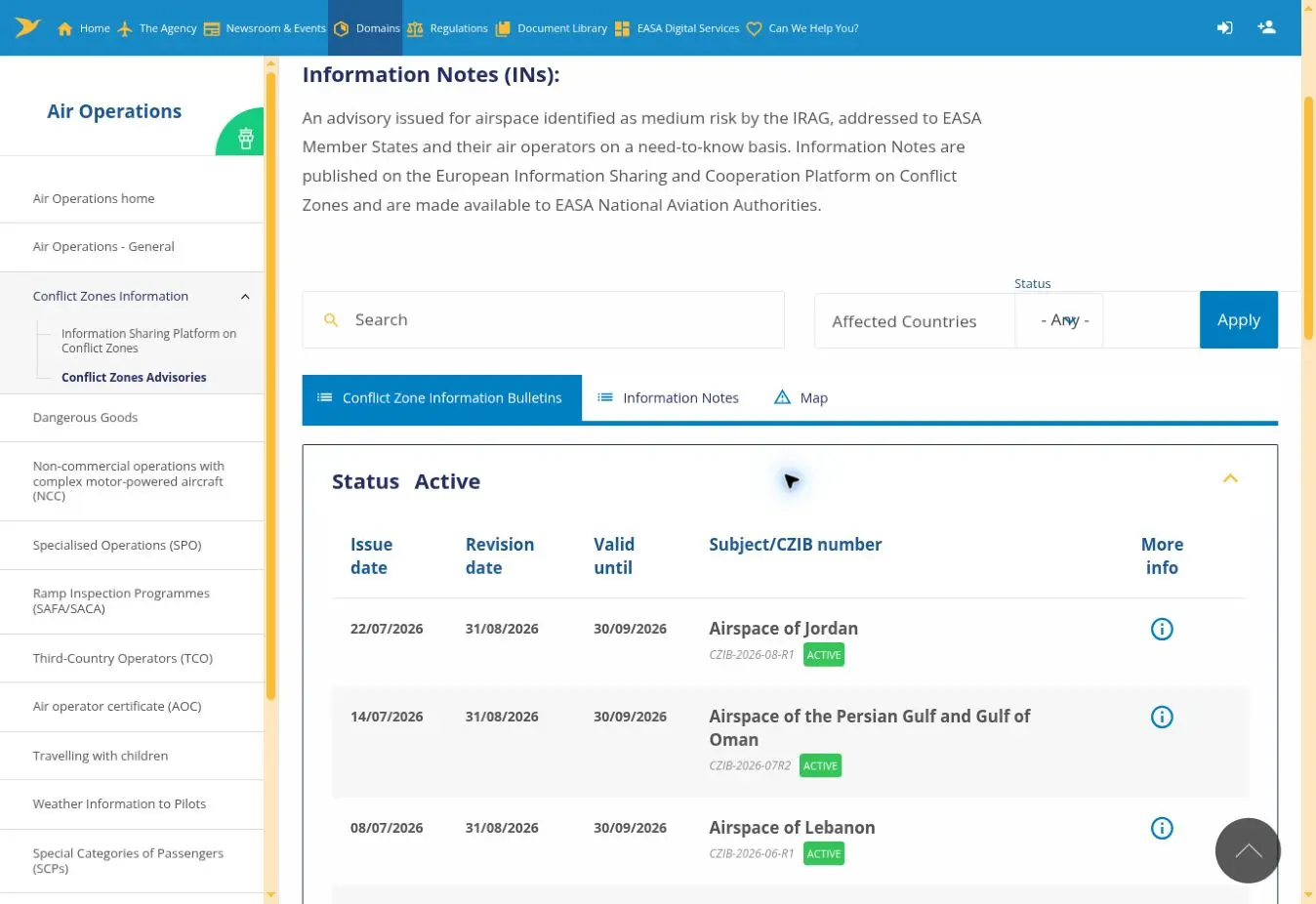
EASA's active bulletin table shows the August 31 revisions for Jordan, the Persian Gulf and Gulf of Oman, and Lebanon. European Union Aviation Safety Agency (opens in a new tab)captured Oil rebuilds a Strait risk premium after the exchange
Evidence, consequence and unknowns
The risk premium woke up
Brent settled 2.71% higher at $90.49 and WTI rose 2.83% to $85.76 after the direct exchange. Reuters reported public shipping data showing only five visible commodity-vessel transits per day over the weekend.
Every barrel carries the argument
The market move is a live transmission channel from tactical events to transport and input costs. The signal is meaningful, but it is still a risk premium rather than proof that the latest strike caused a fresh physical supply loss.
Five visible ships are not the whole Strait
Public vessel visibility is incomplete and some Gulf barrels continue moving. Prices can reverse quickly if the military exchange remains contained or negotiations reopen the Strait.
ATF confirms a breach involving investigation-target data
Evidence, consequence and unknowns
The standalone system was not alone enough
The Bureau of Alcohol, Tobacco, Firearms and Explosives confirmed that attackers reached a standalone system containing information about investigation targets. The agency shut it down, opened an investigation, and designated the breach a major incident.
Segmentation limits blast radius, not consequences
Even bounded compromise can create safety, civil-liberties, and counter-investigation risk when the data identifies targets. Segmentation limited the known blast radius; it does not make exposure of the standalone data harmless.
The attacker is still a blank field
ATF has not publicly identified the intruder or the complete data set. A ransomware group claimed responsibility without publishing samples, so attribution remains unverified.
State Department says the 75-country immigrant-visa pause ended
Evidence, consequence and unknowns
The pause lost in court
The State Department says a court order ended the January immigrant-visa issuance pause for nationals of 75 countries effective August 21. Applicants may submit applications and attend interviews; the notice does not apply to tourist visas.
A policy change is not a visa
A six-month processing barrier has changed for a large, specifically named population. People with affected cases now have a reason to resume case-level follow-up instead of assuming the pause still controls their application.
Consulates still control the clock
The department is still reviewing screening and public-charge policy, and the update does not promise immediate issuance or erase other country, proclamation, admissibility, or capacity constraints.
FSB puts frontier-AI cyber risk at the top of its near-term threat list
Evidence, consequence and unknowns
The watchdog found the accelerator
Financial Stability Board chair Andrew Bailey told G20 finance officials that frontier AI could change the speed, scale, and economics of cyberattacks and undermine market confidence across institutions that depend on a small set of technology providers.
Shared dependencies, shared bad day
This is a systemic-risk regulator connecting model capability, shared third parties, incident recovery, leverage, and stretched valuations in one operating picture. The practical message is resilience and recovery testing, not a prediction that an AI-driven market failure is imminent.
A warning is not an incident
The letter is an official risk assessment, not evidence that a system-wide incident has occurred. The timing, likelihood, and magnitude of the hypothesized transmission remain unknown.
Hypotheses, not prophecies
Weak signals to watch
A water-control vendor's leaked files may lower the cost of follow-on targeting
Observed
A ransomware actor posted what it said were roughly 850,000 files from Micro-Comm, a maker of wastewater control equipment. Reporting found customer names, employee names, product information, and diagrams, but no evidence that a water system was operationally compromised through the leak.
Would strengthen
Targeted phishing using leaked customer context, new scanning of exposed Micro-Comm systems, credential abuse, or utility incidents that reuse the published diagrams would strengthen the hypothesis.
Would weaken or falsify
No follow-on activity, customer inventories showing no exposed management paths, and forensic confirmation that the released files lack usable access material would support the more ordinary ransomware explanation.
Low visible Strait traffic may be settling into a constrained operating baseline
Observed
Reuters reported five visible commodity-vessel transits per day over the weekend while some Gulf cargoes still moved. That is persistent friction, but public tracking does not capture every vessel or commercial workaround.
Would strengthen
Another week of depressed transits, rising war-risk premiums, port notices, insurer restrictions, or sustained queueing outside the Strait would support a durable constrained baseline.
Would weaken or falsify
A quick return toward pre-exchange throughput, a verified navigation agreement, or evidence that dark and undercounted traffic explains the public data would weaken the hypothesis.
Verified and genuinely strange
Weird / high novelty
A synthetic strike video entered presidential wartime signaling
President Trump posted two AI-generated videos depicting explosions at Iran's Kharg Island while saying the oil hub was being destroyed. Reuters reported that no such attack took place; Iran said oil operations continued, and the vice president characterized the post as a message.
Why this is novel: A head of state used synthetic combat footage during an active exchange, forcing analysts to separate policy signaling, intimidation, and evidence inside the same official feed.
Scoped to the exposed audience
Action and decision notes
Airline, corporate-travel, and Gulf route planners
Recheck the current EASA bulletin and carrier routing before departure; distinguish permitted arrival and departure corridors from restricted over-water segments.
The August 31 revision narrows some restrictions and extends others through September 30, so a cached blanket assumption can be wrong in either direction.
Water utilities using Micro-Comm or adjacent internet-reachable control equipment
Inventory exposed management paths, rotate vendor-related credentials during normal operations, and watch for customer-specific phishing or scanning.
The published files may provide targeting context, but current evidence does not establish operational compromise or justify emergency changes to every control system.
Immigrant-visa applicants affected by the former 75-country pause
Confirm case status with the assigned embassy or National Visa Center and continue scheduled application and interview steps.
The State Department says the issuance pause ended on August 21, while other eligibility, vetting, proclamation, and capacity constraints can still apply to an individual case.
Financial-sector resilience, SRE, and third-party risk teams
Test recovery assumptions for a simultaneous cyber incident at one critical AI, cloud, identity, or data provider during the next planned exercise.
The FSB warning is not an incident alert, but concentrated dependencies and faster vulnerability exploitation are reasonable inputs to routine recovery testing.
Readers without Gulf routing, affected visa cases, or named technology exposure
No immediate action; watch for a second military exchange, a verified navigation agreement, or a material expansion in breach scope.
The current evidence supports targeted follow-up by exposed groups, not generalized operational churn.
No numerical theater
Confidence and uncertainty
Limits
- Public reporting and official releases do not provide a complete operational picture of military intent, maritime traffic, airline routing, or compromised data.
- The brief uses a seven-day cyber lookback because breach disclosure and infrastructure reporting lag the underlying events.
Material unknowns
- Whether the next U.S. or Iranian response remains bounded and whether mediators can reopen a reliable navigation channel through the Strait.
- The exact ATF records exposed, the Micro-Comm files' operational value, and whether either incident produces follow-on targeting.
- How quickly consular posts will translate the court-driven visa change into individual case movement.
Likely error modes
- Treating belligerent statements or synthetic media as battle-damage evidence before independent corroboration.
- Reading public vessel counts as complete traffic data or a one-day oil move as proof of durable physical shortage.
- Converting an official risk assessment into a near-term incident forecast, or a nationwide policy update into a guarantee for one applicant.